

 I have been thinking a lot lately about the amount of anxiety leaders are being asked to hold.
AI and technological disruption. Economic and geopolitical uncertainty. Restructuring and cost pressures. An increasingly polarized societal environment. And change occurring so quickly that many people barely have time to absorb one disruption before another arrives.
It is no surprise that the emotional “undercurrent” in many organizations is running high.
Which raises an important leadership question:
What if one of the most powerful things a leader can do in these conditions is help regulate the nervous systems of the people around them?
Psychologists know this phenomenon as co-regulation. And whether leaders know it or not, they are doing it all the time.
We Affect One Another
Co-regulation describes the way one person’s physiological and emotional state can influence another’s.
Stephen Porges’ Polyvagal Theory has provided an influential lens for understanding this process. Our nervous systems are constantly scanning the environment, including other people, for signals of safety or threat. Much of this happens outside conscious awareness.
Daniel Goleman and Richard Boyatzis describe a related phenomenon as resonance: the capacity for emotions to spread between people through our social circuitry, including neural systems
involved in mirroring and interpreting the states of others.
Put more simply: we read each other. All the time.
Think about a leader entering a meeting visibly tense, talking rapidly, interrupting others and reacting sharply to unexpected information. No one has to announce, “Something is wrong.” The room already knows.
Now imagine another leader facing the same difficult situation. She acknowledges the seriousness of what is happening, slows the pace, listens carefully and communicates confidence in the group’s ability to work through it.
The problem hasn’t changed.
But the energy present in the human field has.
That is the power of co-regulation
What Zone Are We In?
One useful way to think about regulation is through an adapted five-zone continuum:
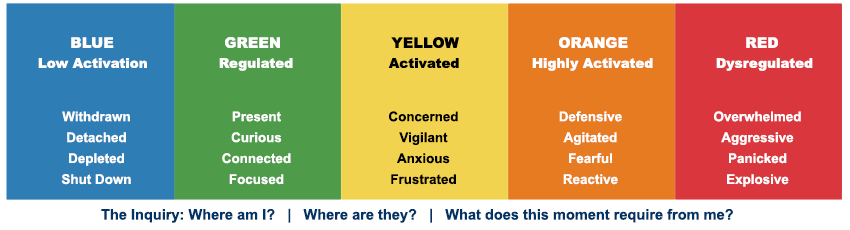
None of these zones is “bad.” Yellow can alert us that something important needs attention. Orange can mobilize action. Red may be appropriate in a genuine emergency. Even blue can provide needed distance or recovery.
The goal isn’t to live permanently in green.
The skill is learning to recognize where we are, where others are, and whether that state is helping us meet what this particular moment requires.
Try Reading the Room This Way
Before or during an important interaction, ask yourself:
Where am I?
What is happening in my body? Am I curious or already convinced? Present or withdrawn? Thoughtful or reactive?
Then widen the lens:
Where are they?
Is the other person, or are the people around me, thinking clearly and engaging productively? Are they unusually quiet? Talking faster? Becoming defensive? Overexplaining? Withholding? Blaming?
And finally:
What does this situation need from me?
Do I need to lower the temperature? Raise the energy? Slow things down? Name what everyone knows but no one is saying? Convey confidence? Become more curious? Set a firm boundary?
That last question turns co-regulation from an unconscious human dynamic into an intentional leadership practice.
Because It’s Happening Anyway
Here is where this gets particularly interesting.
When leaders don’t understand these dynamics, the people around them often begin trying to regulate the leader.
Consider a boss who frequently operates in red: impatient, volatile, easily frustrated, quick to attack.
People learn. They soften bad news. Overprepare. Watch the boss’s mood before raising difficult subjects. Reassure rather than challenge. Eventually, an entire team may organize itself around preventing the leader from becoming dysregulated.
Or consider a leader who spends considerable time in blue: distant, stoic, difficult to read.
People may start working harder to generate a response. They overexplain. Seek reassurance. Schedule unnecessary check-ins. Bring more data. Talk among themselves trying to figure out what the leader is thinking.
Some pursue harder. Others eventually withdraw themselves.
Ironically, behavior a leader interprets as neediness, avoidance, lack of confidence or poor judgment may actually be part of an interpersonal system trying to regulate itself.
And these patterns travel.
The CEO affects the executive team. Executives carry that state into their functions. Their leaders carry it into theirs.
What began as one person’s state can become an organizational undercurrent.
So, How Does a Leader Use Co-Regulation?
Start with yourself.
You cannot reliably help move someone from orange toward green while broadcasting orange yourself.
Notice your body. Slow your breathing and speech. Pay attention to your face, tone and pace. Decide what quality you want to bring into the interaction.
Slow the pace. Anxiety accelerates. Creating space can restore thinking.
Name reality without amplifying it. “This is difficult, and I know people are worried” is very different from either catastrophizing or offering false reassurance.
Communicate confidence in capacity, not certainty about outcomes. “I don’t know exactly how this will unfold. I do believe we have the capability to work through it.”
Get curious. Questions can interrupt defensive certainty: What are we not seeing yet? What else might be true? What do we need to understand before deciding?
Restore agency. When people feel powerless, threat rises. Clarify what can be influenced and what useful action can be taken now.
Use connection. Sometimes the regulating intervention isn’t something the leader says at all. It is creating conditions in which people can hear, support and think with one another.
A Different Way to Think About Leadership Presence
Co-regulation is not about becoming the organizational therapist. Nor is the goal to create an organization in which everyone is calm all the time.
Great organizations contain urgency, excitement, disappointment, anger, disagreement and fear.
The opportunity is to become more attuned to what is happening in ourselves and in the human system around us. The questions to heighten our attunement and feed our discernment include:
Where am I?
Where are they?
What is happening between us?
And, perhaps most importantly:
What does this moment require from me to help us access the best thinking, strongest connection, and highest possibility available here?
Sometimes the answer will be calm.
Sometimes energy.
Sometimes compassion, urgency or a very firm boundary.
The leadership skill isn’t about staying in one zone.
The leadership skill is learning to notice where you are, sense where others are, and intentionally help create the conditions in which people can do their best work.
So, what is your nervous system bringing into the spaces in which you lead, formally and informally? And how can you use your presence to expand what becomes possible?