

 A few weeks ago, I wrote about something we don’t talk about nearly enough in leadership: the ways our nervous systems are affecting one another all the time.
My article, Your Nervous System Is Leading, Too: The Power of Co-Regulation, generated a number of thoughtful responses. One reader raised an especially important challenge. People, he pointed out, aren’t passive receivers of whatever state a leader happens to be “broadcasting.” They are interpreting us through our words and expressions, previous interactions, expectations and the larger context.
I agree. And I think that observation takes the idea of co-regulation somewhere even more interesting.
Co-regulation isn’t simply something one person does to another. It happens between us.
We Are Part of a Feedback Loop
Imagine that you walk into a difficult conversation already somewhat anxious. The person across from you looks tense. Her answers are short, and you detect irritation.
Your nervous system registers that. Perhaps your chest tightens slightly. You start talking faster or begin to overexplain. She experiences the change in you, her irritation increases, and you detect that change in turn. Neither of you is a passive recipient. Each person’s state and behavior are continually becoming part of the conditions to which the other person responds.
Research on interpersonal emotion regulation increasingly reflects this more dynamic view. Psychologist James Coan’s Social Baseline Theory, for example, proposes that our brains evolved with an expectation of access to other people. We use relationships as resources for managing threat, effort and emotion. Psychologists Emily Butler and Ashley Randall similarly describe emotional co-regulation as bidirectional, with each person’s emotional state influencing and responding to the other’s over time.
In other words, we regulate with one another.
And that means the loop can begin moving in a more helpful direction, too.
Imagine that instead of accelerating when you encounter the other person’s tension, you become more grounded. You slow your breathing, soften your face and listen rather than immediately defend. Perhaps you lower your voice slightly and say, “Something shifted just now. Can we slow this down for a minute?”
The other person’s shoulders drop. You see that, and something in you settles further. You become more curious. Your curiosity makes it easier for them to become less defended, and their reduced defensiveness makes it easier for you to remain open.
As you settle, it becomes easier for the other person to settle. As they do, their changing state feeds back to you, making it easier for you to stay grounded and open. Each of you begins giving the other different information to respond to. The same feedback loop can take us in very different directions:
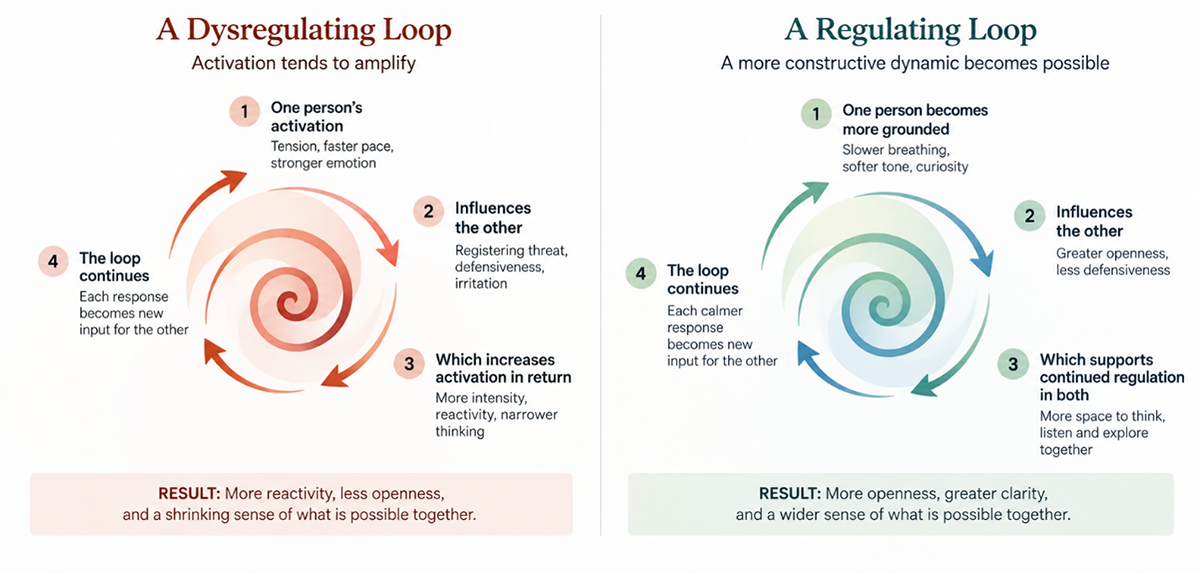
That’s the reciprocal nature of co-regulation. We can’t determine what happens in another person’s nervous system, but we are continually participating in the conditions affecting what happens next.
Regulation Doesn’t Always Mean Calming Down
There is another misconception about co-regulation worth clearing up. Regulation isn’t synonymous with becoming calmer.
Our nervous systems continually adjust activation upward and downward. Sometimes what a situation needs is down-regulation. The room is anxious, people are talking over one another, someone is angry, and thinking has narrowed. The pace needs to slow.
At other times, greater activation is exactly what is needed. The meeting is flat. People have withdrawn. Everyone is politely avoiding the issue. Energy has disappeared from the room. More calm isn’t likely to help.
That moment may need energy, challenge, movement, humor, candor or a provocative question. Someone may need to say, “We’re talking around this. What’s the conversation we actually need to be having?”
This is why I don’t think the goal of co-regulation is to become the calmest person in every room. The more useful capacity is attunement: noticing what is happening in me, what appears to be happening in others, and what is developing between us.
Then comes the question I keep returning to:
What does this moment require of me?
When Someone Suddenly Shoots into Red
In my earlier article, I used a five-zone continuum, from blue through green, yellow and orange to red, to describe shifts in nervous-system activation. Green represents a state of relative regulation and connection, while orange and red reflect progressively higher levels of activation, often associated with a growing sense of threat. The important point wasn’t that one zone is “good” and another “bad.” It was learning to notice where we are and whether that state is serving what the moment requires.
There is a version of this that comes up frequently in my coaching work and causes a fair amount of consternation for even very experienced leaders.
A leader is having what seems to be a difficult but manageable conversation with a boss, colleague or direct report. Then, seemingly out of nowhere, the other person shoots into red. Their voice rises. Their face changes. They become accusatory, begin interrupting, or say something surprisingly harsh.
Almost instantaneously, the person sitting across from them feels their own system activate. Of course they do. Our nervous systems are designed to register potential threat. The opportunity lies in whether we can notice that activation early enough to retain some choice about what we do with it.
Perhaps I feel my chest tighten. My face gets hot. I have an immediate urge to correct what was just said, defend myself or push back just as hard.
Can I catch myself there?
Can I feel my feet on the floor and lengthen my exhale? Can I resist matching the other person’s pace, volume or intensity? Can I remind myself, I don’t have to go there with them?
And then there is another level of skill: can I remain sufficiently attuned to the other person to respond to what may be happening for them, rather than simply working hard to control what is happening in me?
If the relationship and circumstances allow it, that might mean naming the shift: “I’m noticing that the intensity just went up considerably.” Or, “Something about what I just said really landed. Help me understand what happened.” In another situation, it might mean saying, “I want to stay with this conversation, and I think we need to slow it down.”
The wording matters. “You’re getting really defensive” tells the other person what is wrong with them. “This conversation suddenly feels much more charged” names something that is happening between us and gives both of us an opportunity to work with it.
A Few Things to Practice Before You Need Them
The middle of a heated conversation is a difficult time to acquire a new skill. These are practices worth developing when the stakes are lower so they become more accessible when they aren’t.
- Learn what your own acceleration feels like early.
Most of us can recognize ourselves once we’re fully activated. The more useful skill is noticing the first 10 percent. Maybe your jaw tightens, your breathing becomes shallower, you lean forward, your voice speeds up, or you suddenly become very invested in proving your point.
Those early signals are useful data. Catching them gives you more room to choose what happens next.
- Have a reliable way to interrupt your own momentum.
HeartMath’s Quick Coherence technique is one approach I use with some of my clients: shift attention toward the area of the heart, slow the breathing and bring to mind a genuinely regenerative feeling or attitude. A simpler intervention can work too. Lengthen your exhale. Feel both feet pressing into the floor. Release your jaw and shoulders.
You aren’t trying to make yourself perfectly calm. You’re trying to recover enough capacity to think, notice and choose.
- Change one thing in the interaction and watch what happens.
Slow your speech. Lower your volume. Allow three seconds of silence rather than immediately filling it. Stop explaining and ask a genuine question. Move from “Here’s why that’s not what I meant” to “Tell me what you heard me say.”
Then pay attention. Did anything shift?
This is where co-regulation becomes less like a technique we perform on another person and more like an experiment in the human field between us. Change one thing you are bringing into the interaction and become curious about what happens next.
- Learn to regulate in both directions.
When activation is too high, we can slow things down: breathing, pace, volume, movement, information flow. When activation is too low, we may need to do the opposite. Stand up. Move. Bring more vocal energy. Ask a provocative question. Introduce a little humor. Name the tension everyone is avoiding.
The question isn’t, “How do I make this calmer?” It is, “What level of energy will help us do what we need to do here?”
- Notice when the other person gives you something different.
A breath. Shoulders dropping. More eye contact. A question instead of an accusation. A moment of humor. A shift from certainty toward curiosity.
Don’t rush past it. That change is new information entering the interaction. Let your own nervous system register it.
What Does This Moment Require of Me?
Recently, a senior leader I’ve been working with told me that one question from my previous article had stayed with him. He was on a leadership call in which he sensed considerable anxiety beneath the conversation. There was something several people seemed to know or feel, but no one was saying it.
He remembered the question: What does this moment require of me?
His answer wasn’t to calm everyone down. It was to say the thing.
He articulated what he believed people were holding but not voicing and helped the group confront what that implied about a sensitive communication they needed to make to employees.
I loved hearing that story because it captures something essential about co-regulation. Sometimes a human system needs calm. At other times it needs energy, reassurance, challenge, silence or candor. Sometimes it needs one person who is regulated enough to say what everyone else is feeling.
That, for me, is the deeper practice: noticing the feedback loops we are part of and becoming more skillful at working with our part of them. We can’t choose another person’s state, but we can become more conscious of what we are bringing into the interaction, more responsive to what comes back, and more capable of adjusting again.
Perhaps that is where our greatest opportunity lies. Not in perfecting our ability to stay regulated regardless of what is happening around us, but in becoming more attuned to the living, reciprocal dynamic between us.
Because every interaction takes place within a field. And each of us helps shape what becomes possible there.